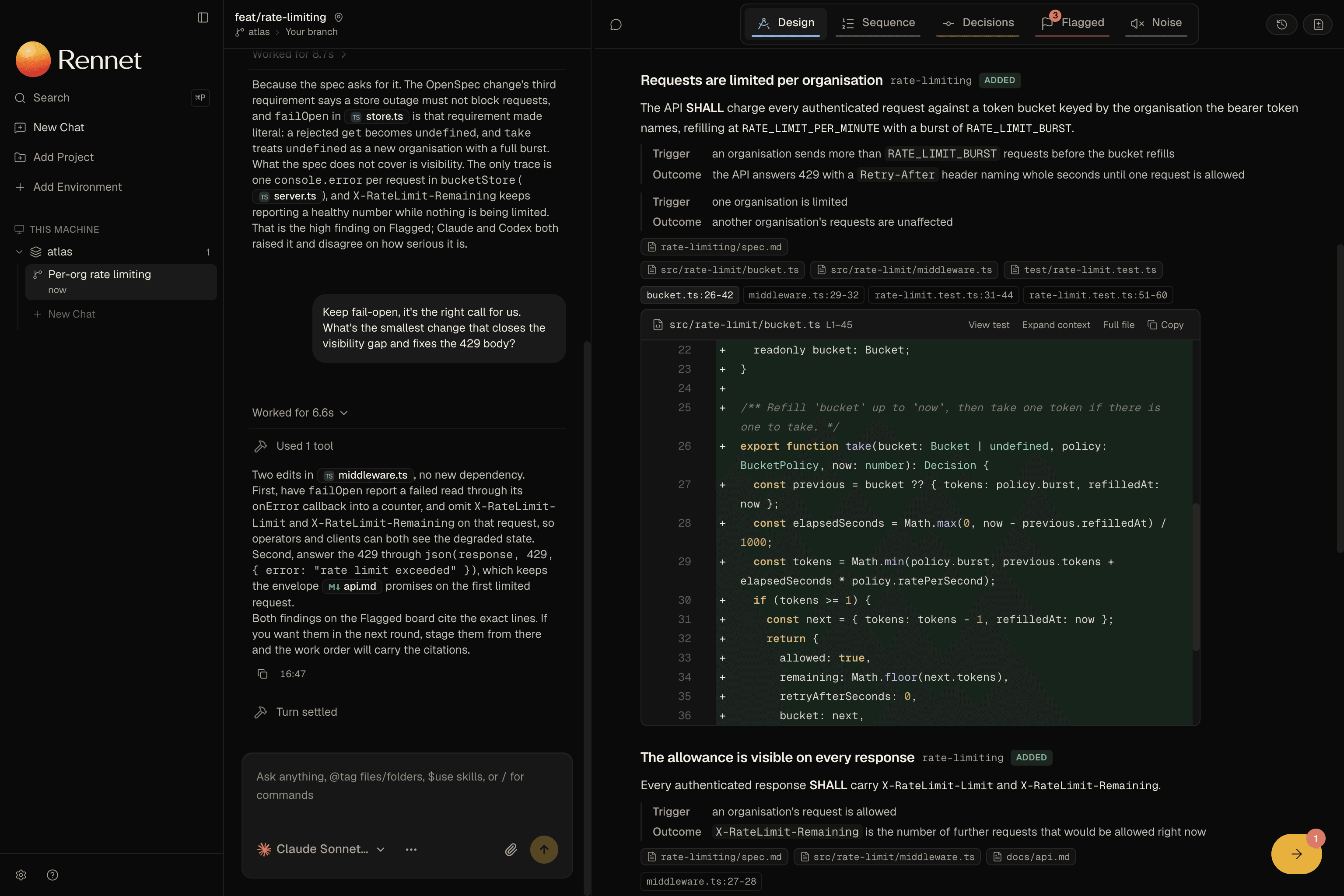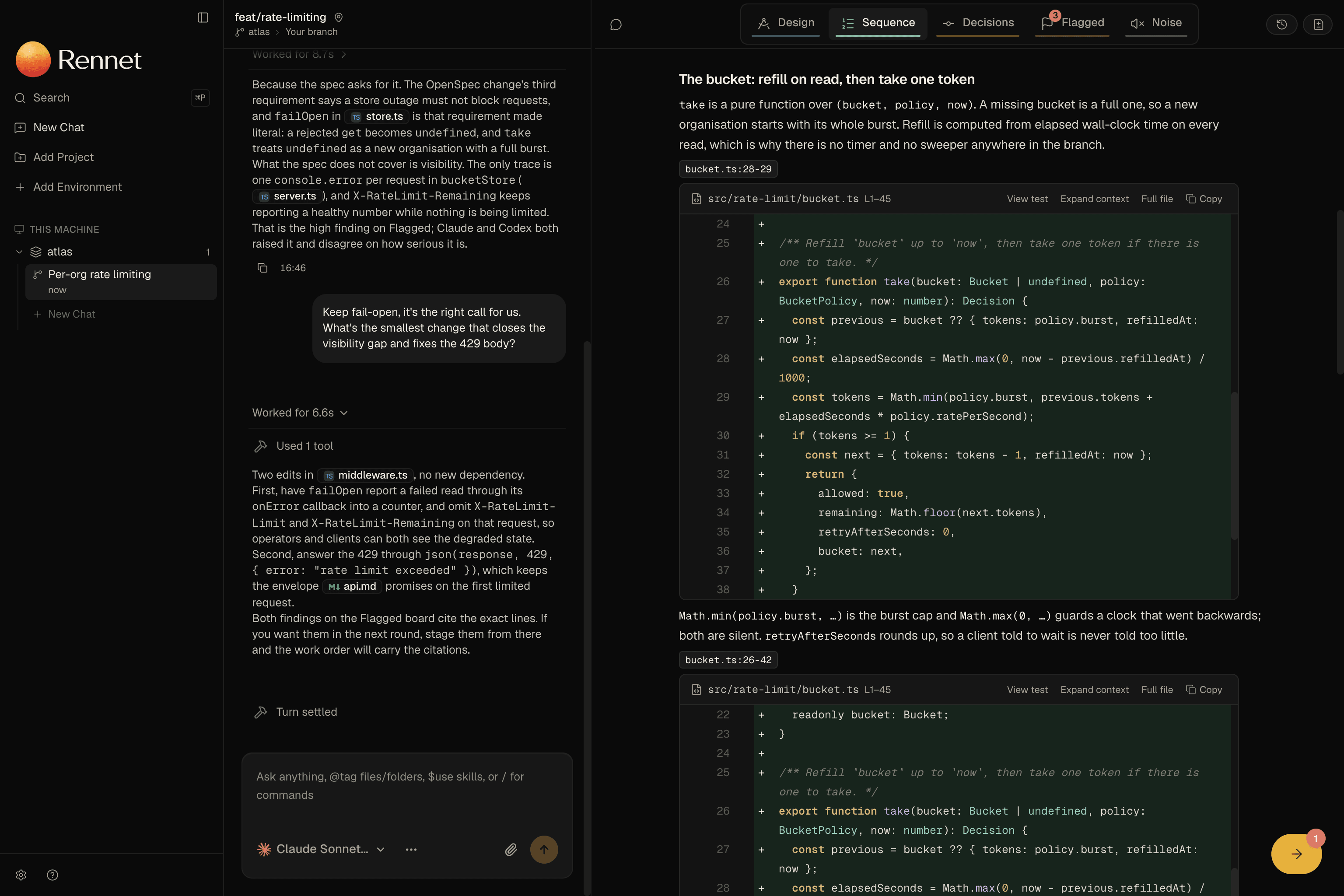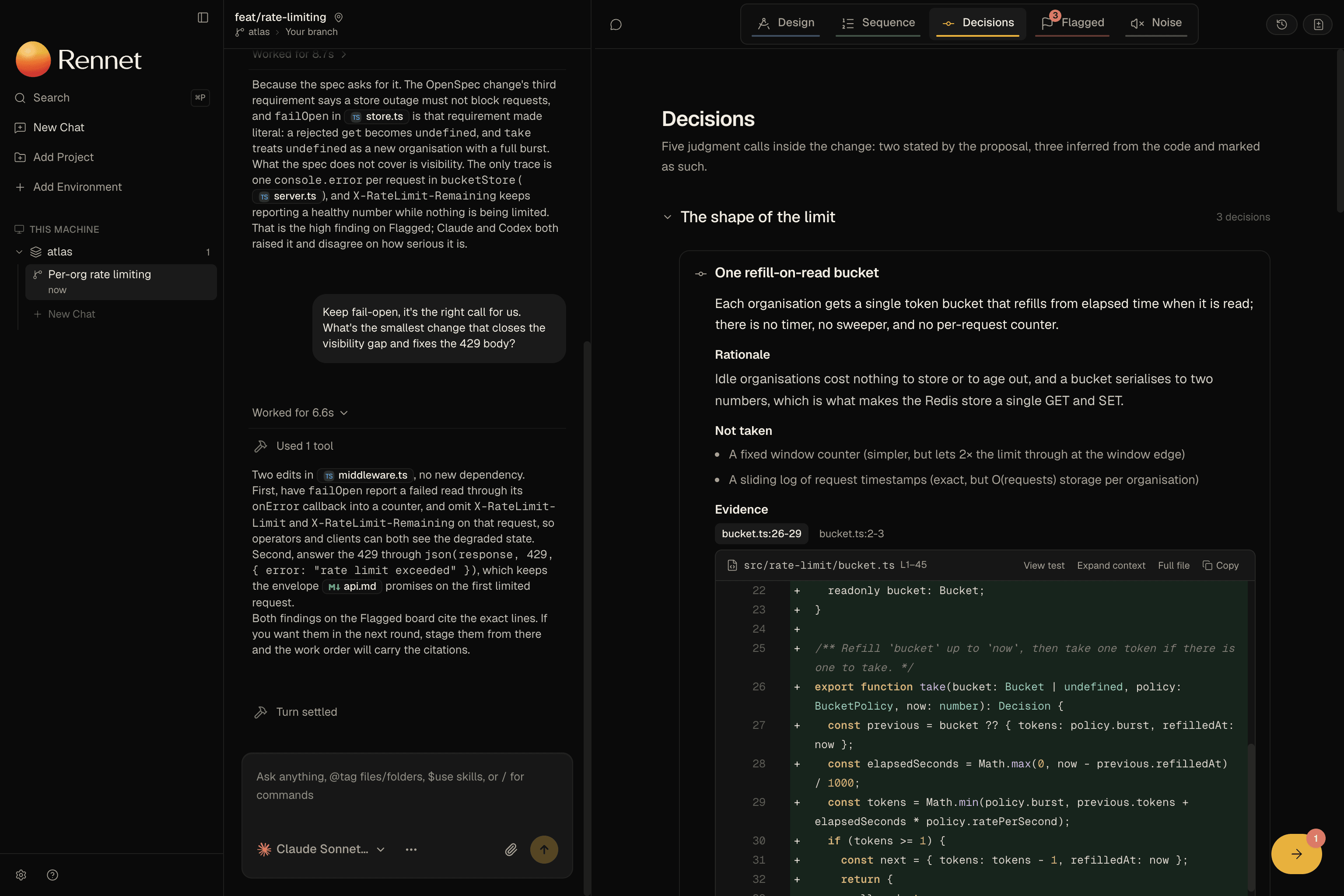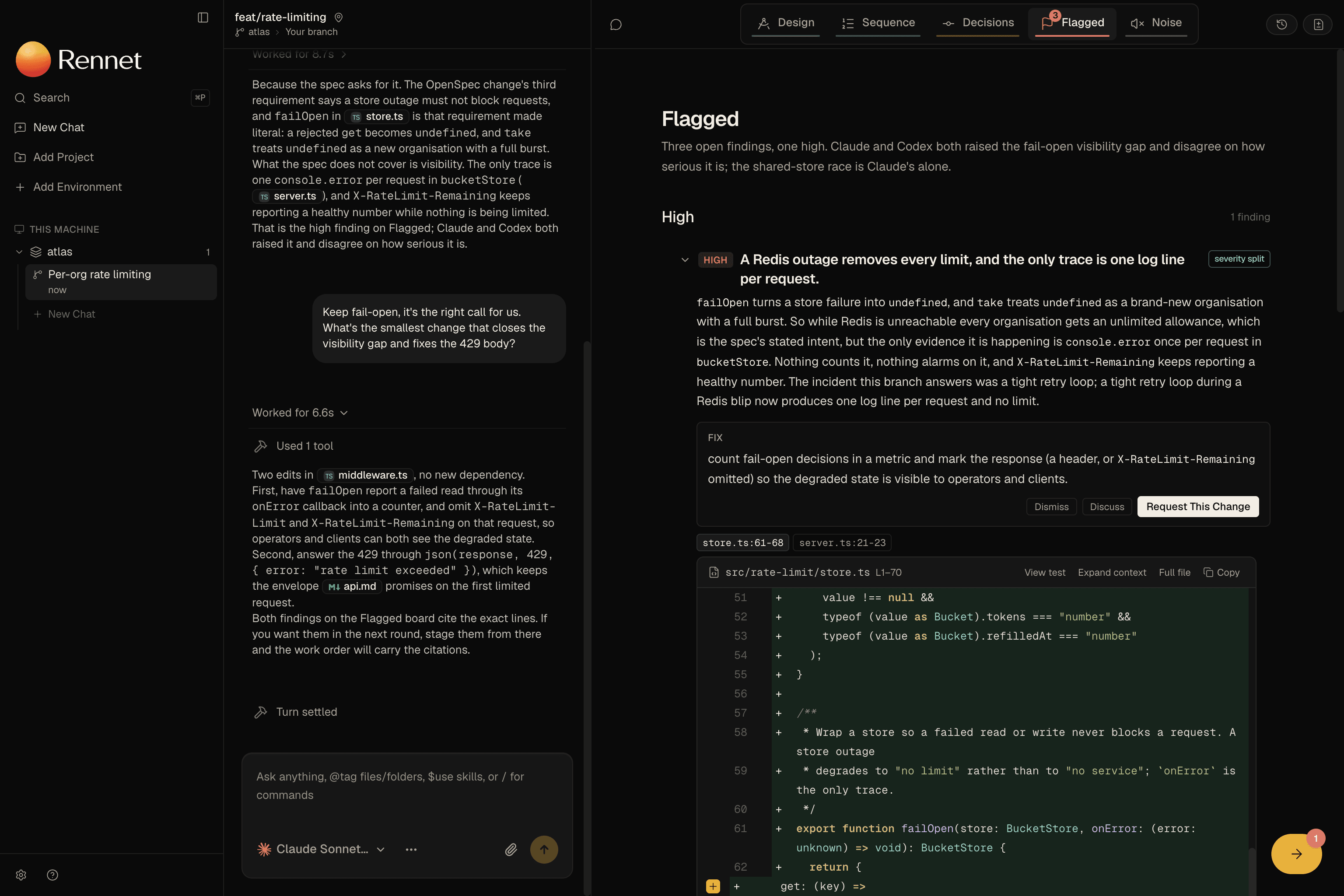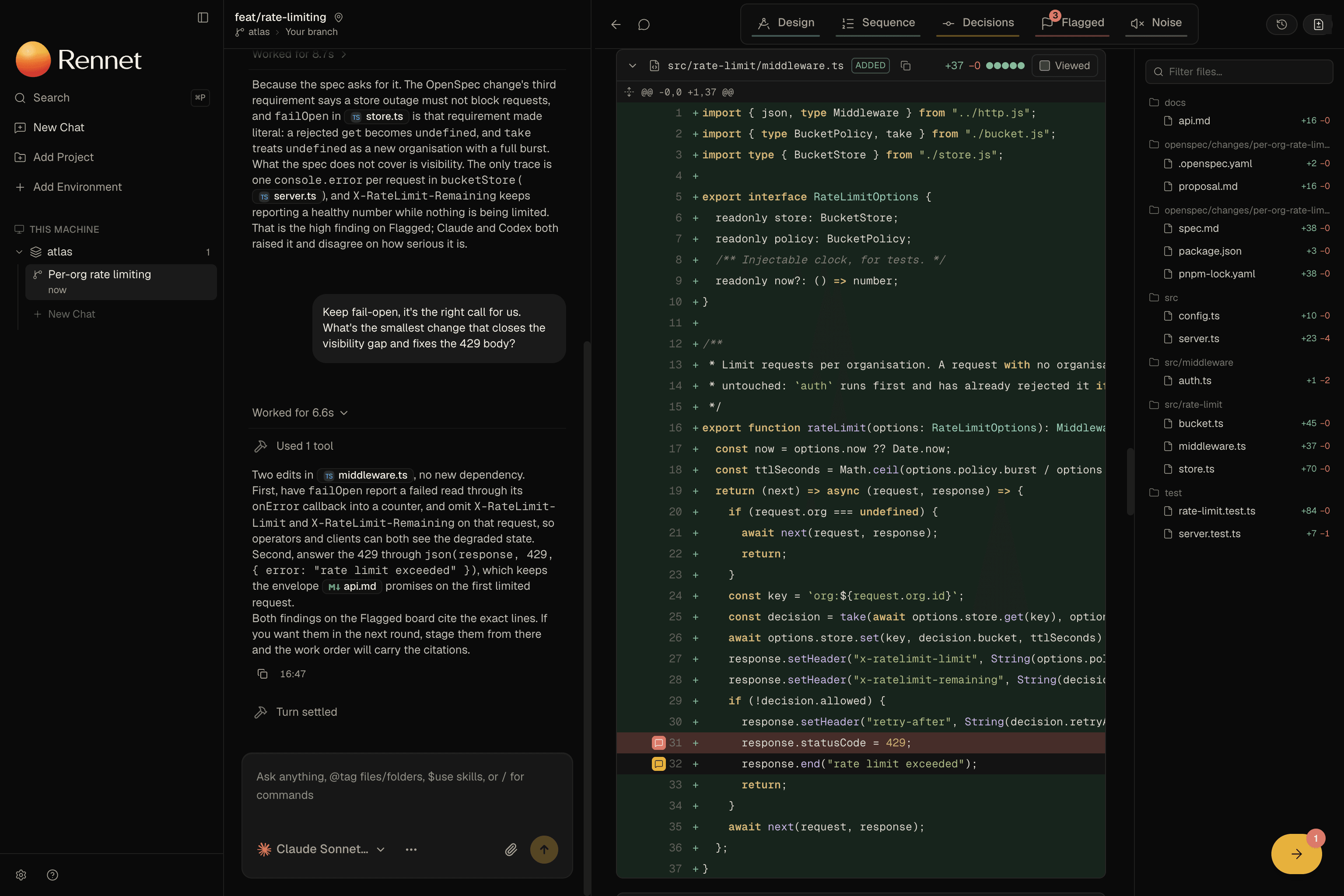
You stopped writing the code.
You still have to answer for it.

Rennet turns large changes into a review you can understand, question, refine, and stand behind.

Not for vibe coders. For agentic engineers.

Available now · Free · Open source · MIT

No API-key setup. No telemetry. Uses the Claude Code and Codex already on your Mac.

  1. Raw change1,872 lines
  2. Related changes4 parts
  3. Human decisions11 calls
  4. PR reviewReady to post
From raw change to accountable judgment. Illustrative review data.

AI can produce more code than a human can hold in their head.

Pull requests have ballooned. The old file-by-file reading ritual now asks the human context window to keep pace with machines that never get tired.

Rennet does the structural reading work: grouping, ordering, narrating, and surfacing decisions. You still read the code. Your attention goes where engineering judgment is actually required.

A review harness

A coding harness points a model at your codebase so it can write. A review harness points models at a change so you can read. The harness does the structural work. You do the deciding.

Two sides of the same responsibility.

Whether the code is yours or a teammate’s, the job is to understand what carries your name.

Before you submit

Your own work

Your coding agent finished the branch. Before you open the PR, Rennet helps you understand the change, catch issues, refine the implementation, and fulfil the human review work the agent cannot own for you.

  1. Branch

    Review committed and working-tree changes.

  2. Refine

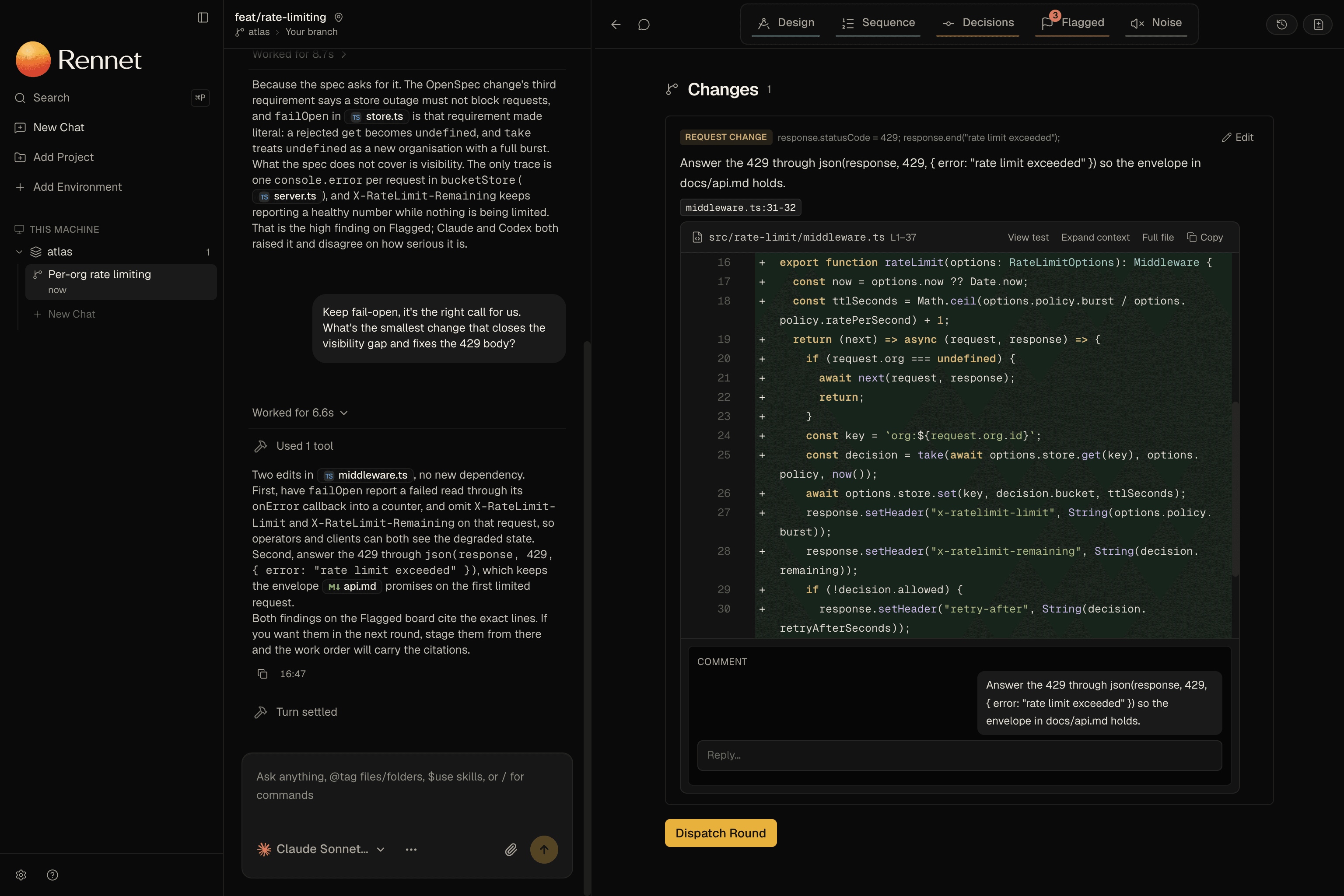
    Turn your calls into focused work for your coding agent.

  3. Re-read

    Rennet takes a new snapshot of the branch and re-reviews only what changed.
When they submit

Someone else’s work

A teammate sends an agent-written PR. Rennet walks you through it in an order you can actually follow, keeps the real code under your hands, and turns your decisions into one normal GitHub review in your own voice.

  1. Pull request

    Read the promise, structure, and changed code together.

  2. Question

    Question any finding, decision, or line.

  3. Review

    Edit and post the exact review GitHub receives.

Don’t just read the diff. Talk to it.

Ask what changed, why it changed, how it fits the rest of the repo, or whether a failure path is intentional. The conversation stays attached to the review and its code.

src/rate-limit/store.tslines 84–101
− return store.get(key)+ return store.get(key).catch(() => fallback)
You

Why does this fail open instead of blocking the request?

Claude Code

The PR treats rate limiting as protective infrastructure, not an availability dependency. The fallback preserves service when the store is unavailable.

Your Claude Code. Your Codex. Already connected.

Rennet finds the Claude Code and Codex already installed on your Mac and signs in as you already do. No new API keys. No extra bill from Rennet.

Claude CodeExisting install · existing account
CodexExisting install · existing account

Two independent reads.
Disagreement is where you look.

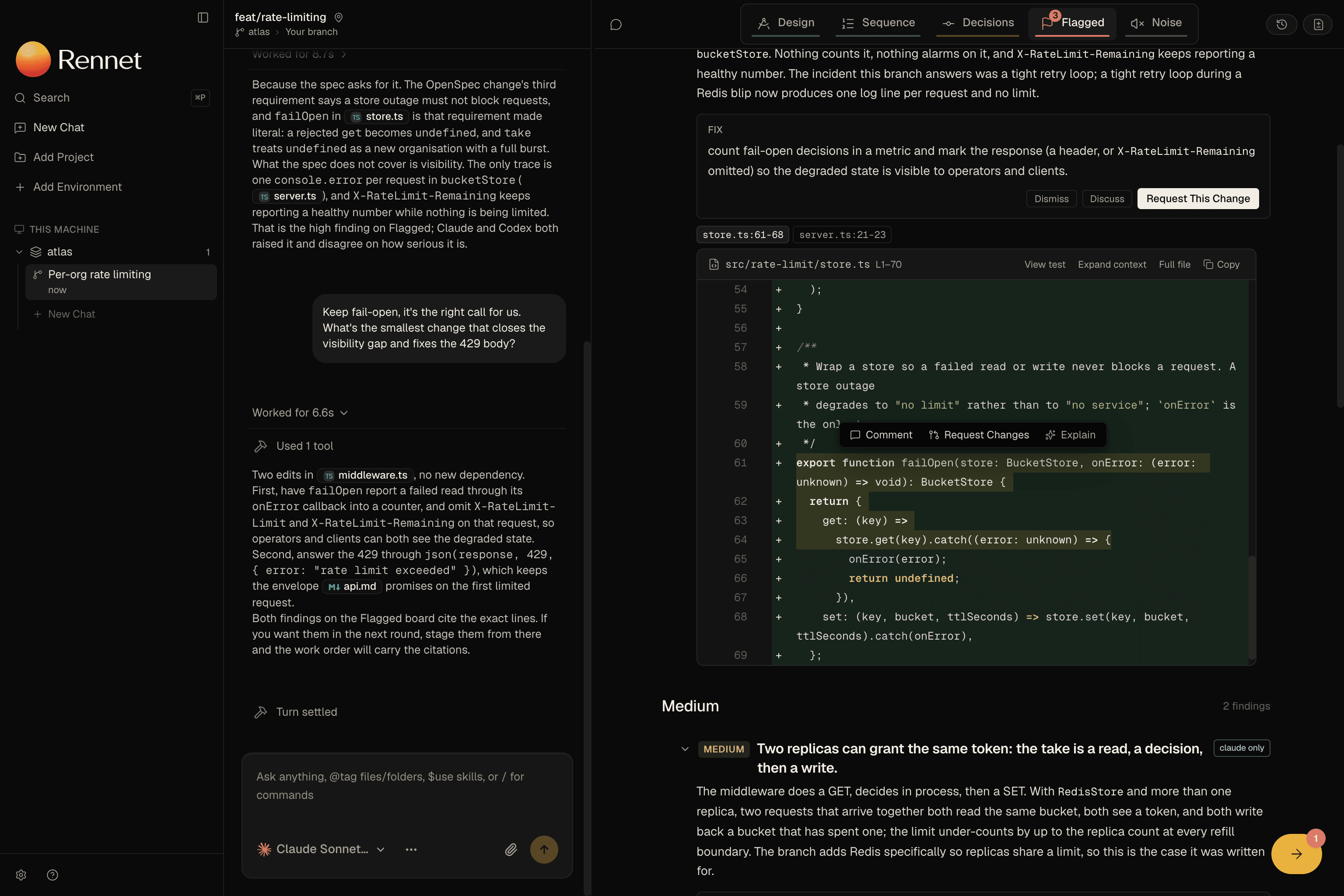
Claude and Codex review the same evidence independently. Rennet shows where they agree and, more importantly, where they split. Nothing is averaged into false consensus.

Claude

Fallback masks a real storage outage.

Request change
Codex

Availability policy supports this fallback.

Accept with note

Models disagree · human judgment required

Illustrative dual-review output

A repo map that grows with the repo.

Rennet walks the code itself — files, workspaces, symbols, references, tests, owners, dependencies — then uses a model to explain what that structure means, with the evidence to back it.

When the branch you review against moves forward, the affected areas are remapped and what Rennet has learned is refreshed. You start from the repo as it is now, not a stale picture of what it used to be.

atlas/current · main@8d2f1a
Deterministic discovery47 workspaces · 3,284 symbols · 612 test links
Evidence-backed knowledge9 conventions · 4 boundaries · 3 active decisions

Main moved forward12 affected areas remapped · learned knowledge refreshed

Illustrative repository data

The code never disappears.

Move from overview to evidence without losing your place. Rennet changes the reading order, not the need to read.

atlas · feat/rate-limitingsnapshot 8
Rennet review surface with ordered changes, code, and an attached conversation
Current product wireframe

One app. A window or a tab. Any of your machines.

Run Rennet as the desktop app or open it as a browser tab served straight from your own machine — both are the full product, no read-only mode, no feature in only one. Review from another computer or your phone by pairing it over Tailscale. There is still no hosted anything: the remote device talks straight to your machine, and it never sees a path on it.

Five angles.
One complete review.

Change altitude without losing the decision or its evidence.

  1. Spec

    Read the change against what it promised.

  2. Sequence

    Follow the work in the order it builds on itself.

  3. Decisions

    See the judgment calls hidden inside the change.

  4. Flagged

    Work through what the models flagged, and where they disagree.

  5. Noise

    Keep generated churn out of your way.

Local-first, without pretending the models are local.

Rennet has no backend and no telemetry. The coding agents you use still send context to their own providers under your existing accounts. Rennet tells you that plainly.

Rennet backend
None
Telemetry
None
API key setup
None
Supported at launch
macOS
Licence
MIT

The questions worth asking.

Is this another autonomous review bot?

No. Rennet does the structural reading work. You inspect, question, edit, and post the judgment another person sees.

Does dual review mean a model decides by majority?

No. Claude and Codex run independently. Agreement is evidence; disagreement is a signal for you, never something Rennet averages away.

Does “local-first” mean nothing leaves my machine?

Rennet itself has no backend or telemetry. The coding agent you use still talks to its provider under its own terms and sign-in.

Not for avoiding the code.
For engineers accountable for it.

Make the next change digestible.

macOS at launch. Watch the repo for what’s next.